Meta's Adaptive Ranking Model makes creative diversity a bigger edge
Meta just made the final ranking decision inside the auction a lot smarter, and that pushes advertisers toward one clear advantage: more creative volume, more creative diversity, and more coverage.

Core idea
The more precisely Meta can understand the moment, the more valuable it becomes to have a wider range of distinct creative responses ready for that moment.
Treat this as a real shift, not another model update
It is easy to look at a release like this and file it under "Meta made the algorithm smarter again." But this one is bigger than that. Adaptive Ranking Model upgrades the part of the system that makes the final call on which ad actually wins the auction.
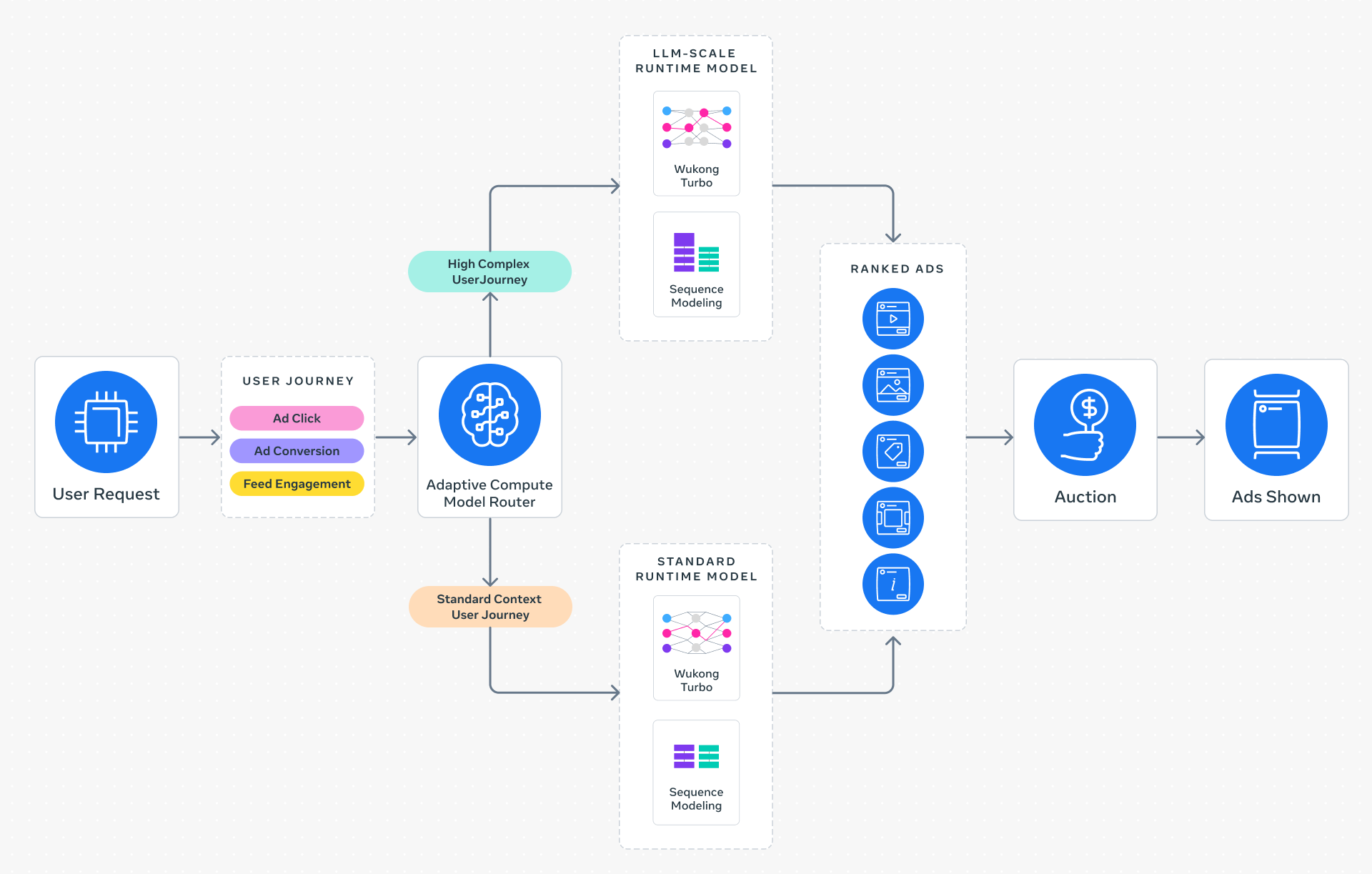
That matters because the last step is the one that decides which creative gets shown. Meta says it has scaled that ranking layer to LLM-level complexity while keeping the speed required for ads delivery. The important part for advertisers is not the engineering flex. It is that the model can now understand more context before it chooses.
Meta's core change is that it computes user understanding once per request and shares it across candidate ads, instead of redoing the same heavy work ad by ad. In plain English, the platform can spend more effort understanding the moment and still make a decision fast enough to serve ads at scale.
Meta's releases all keep pushing in the same direction
The best way to read this launch is alongside the other major Meta releases from the last couple of years. Andromeda improved retrieval. Other updates improved how Meta models user behavior and intent. Now Adaptive Ranking Model upgrades the runtime ranking layer that makes the final decision.
Those releases do not sit in separate boxes. They compound. Better retrieval means stronger candidates make it into the auction. Better user understanding means Meta has a richer read on what is happening in that moment. Better ranking means the platform can make a sharper choice between the ads competing for that impression.
When you zoom out, the direction is pretty clear: Meta keeps getting better at matching intent with creative. And if the platform keeps improving at matching, then advertisers need to keep improving at giving it a wider set of strong creative options to choose from.
Give the model more real creative choices
As Meta gets better at reading context, each auction becomes a little more specific. Different behavior sequences, different content patterns, different signs of intent all create slightly different situations for the model to respond to.
That is why creative diversity matters so much. If Meta can understand the moment with more nuance, it helps to have more than one kind of message ready for that moment. One creative might work because it teaches. Another might win because it shows the product. Another might land because it speaks directly to hesitation, urgency, or identity.
This is where creative volume becomes valuable. Not because the platform wants noise, but because the platform benefits from coverage. More creative only helps when it gives the model more genuinely different answers to choose from.
- Different problem framings for the same offer
- Different awareness-stage messages, from broad education to direct conversion
- Different proof structures, such as social proof, product demonstration, or founder-led explanation
- Different visual pacing, formats, and opening patterns that fit different consumption moments
Build for coverage instead of chasing more control
For media buyers, the takeaway is not to fight harder for manual control. It is to improve the inputs. Spend less energy on slicing the account into ever smaller pieces and more energy on building a creative library that covers more motivations, more awareness stages, and more buying moments.
This is also another argument for consolidation. When Meta's automation is stronger at both retrieval and ranking, cleaner structures usually give the system more room to do its job. The leverage moves upstream, into strategy, messaging, and creative breadth.
Patience matters more too. A smarter model still needs data. If every learning phase gets interrupted by frequent edits, constant resets, or impulsive swaps, you make it harder for the system to calibrate against the deeper context it is now using.
- Plan creatives as a portfolio of distinct angles instead of isolated one-off assets
- Create enough volume to cover multiple intents and stages of awareness
- Use cleaner campaign structures so the system can learn across a broader opportunity set
- Judge new creative by whether it expands coverage, not just whether it looks slightly different
Make creative operations part of the edge
Once you accept that Meta rewards broader creative coverage, the bottleneck becomes obvious. It is not just strategy. It is production. Most teams do not struggle because they cannot think of another angle. They struggle because turning that angle into finished creative over and over again is expensive, slow, and messy.
The teams that benefit most from this shift will be the ones that can produce more distinct creative without blowing up workflow. They will have clearer systems for turning one offer into multiple hooks, multiple proof structures, multiple visual treatments, and multiple messages for different stages of awareness.
That is why creative infrastructure matters more every year. If Meta keeps improving its ability to match the right ad to the right moment, then the brands with the best operational ability to generate meaningful creative breadth will keep gaining ground.
Read next on Variads
Modular Templates
See how to build repeatable creative systems instead of one-off ad production workflows.
Open pageCreative Compatibility
Map which messages, scenes, and assets can work together as your library expands.
Open pageCreating with Variads
Walk through a simple example of how a modular creative system creates more valid ad combinations.
Open pageThe takeaway
Meta's releases keep pointing in the same direction: better automation increases the value of better creative inputs. As the platform gets better at understanding intent and evaluating context, advertisers need broader creative coverage, not just more manual control. The teams that win will be the ones that can consistently ship more distinct, strategically useful creative options into the system.