Creative Compatibility is the secret sauce to scaling video ad production.
Why defining which assets can appear together in the same ad is the revolutionary idea that turns a library of modular creatives into thousands of on-brand video ads, without hand-making a single combination.
You’ve got a modular template and a library of assets. Creative compatibility is where you decide how they combine. Map which assets can appear together (and which can't) so every generated ad is valid and on-brand. Export the result via the creative feed.
The creative scale problem every video ad team hits
Performance and brand teams are asked to deliver more video creative than ever. Every platform wants fresh creative; every segment wants relevance; every test wants variants. The number keeps going up: hundreds or thousands of ads per campaign.
But creative teams are still built like craft shops. They make one ad, then another. The math never works: either the team burns out, quality drops, or both.
The obvious answer is to reuse and recombine: same hook with different product shots, swap CTAs, rotate value props. In theory, a small set of building blocks could generate a huge set of unique ads. In practice, that only works if you control which blocks ever appear in the same ad. Wrong hook + wrong product = nonsensical or off-brand. Do it at scale without rules and you get chaos. So the real question is not whether to recombine, but how to recombine in a way that stays on-brand. That’s what creative compatibility solves.
Why the old ways of scaling creative fall short
Teams have tried to scale in a few main ways:
- Full-service production: agencies or in-house making each ad by hand. Quality, but it doesn’t scale. Cost and time per asset stay high.
- Pure automation: dynamic creative, feed-based ads, one-size-fits-all templates. Output scales, but too often the result is generic, off-brand, or full of combinations that never should have existed.
- AI-generated creative: the same shortcoming applies to generating ads entirely with AI. AI can produce huge volume and endless variation, but it still lacks creative control. You can't define which concepts go with which; you can't enforce brand rules across combinations. You get scale, but not the guardrails that make that scale safe and on-brand. Creative compatibility is what gives you both scale and control by letting you set the rules and letting the system only generate what fits them.
- The gap: a way to produce at scale while keeping creative control. Most tools treat the ad as the unit of work: you design whole ads, or you hand over control to an algorithm. What’s missing is a layer in between: which pieces are allowed to go together. That layer is creative compatibility.
Without it, modular creative is either underused (teams hand-pick combos because they don’t trust the system) or misused (the system generates everything and someone cleans up the mess). With it, you set the rules once. The system only produces combinations that match. Scale and control align.
Rule-based mapping
Creative compatibility is the set of rules that define which assets can appear together in the same ad. You map compatibility between assets. The system only generates ads from combinations where every pair is marked compatible. So you get scale (thousands of valid combinations) without ever generating an invalid or off-brand one. Those combinations can be exported via the creative feed.
Like a permission matrix
Asset A can appear with B and C but not D. Asset B with A, C, and D. When the system builds an ad, it fills each cell with an asset but only allows combinations that satisfy every pairwise rule. The machine does the combinatorics; you define the guardrails.
What creative compatibility actually is
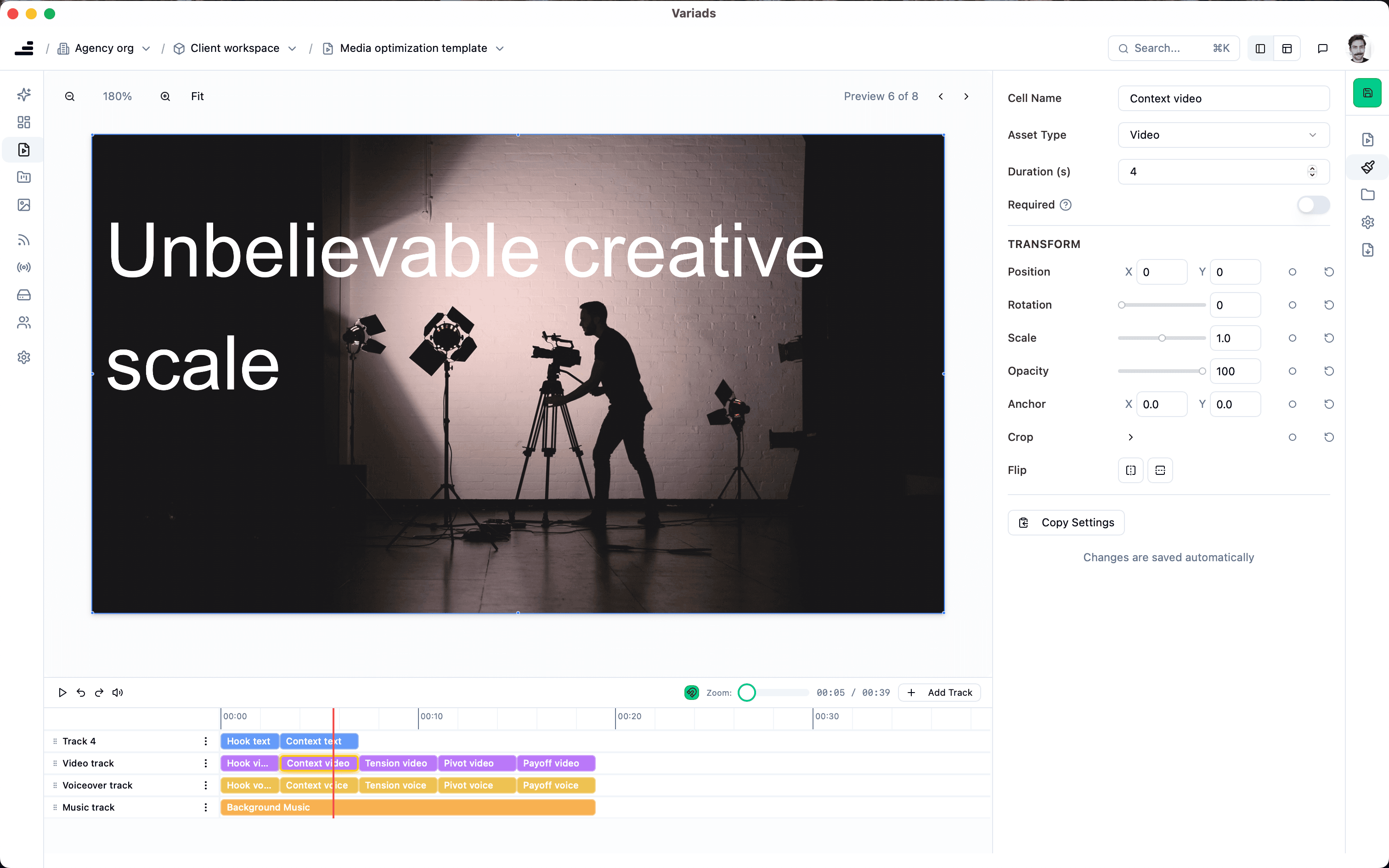
In Variads you work with modular templates: timelines built from cells (hook, value prop, product shot, CTA). Each cell can be filled by one of many assets of the right type. The template gives structure; the asset library gives options. But the number of possible combinations can be enormous (e.g. five hooks × five value props × five product shots × five CTAs = 625 possible ads). Many will be wrong: a hook that promises one thing with a product shot that shows another.
Creative compatibility is where you decide, explicitly, which assets can sit in the same ad. You map it. The system then only generates ads where every pair of assets in that ad is compatible. Rule-based scale.
How it works in practice
- Start with a modular template: timeline with named cells (Hook, Value Prop, Product, CTA). Each cell has a type and can be required or optional.
- Build or import an asset library: assign assets to the right cells (hook videos to Hook, product clips to Product, etc.).
- Define compatibility: for each asset, set which other assets it can appear with. Per pair or by group (e.g. “campaign A” assets compatible with each other, not with “campaign B”). Compatibility is bidirectional.
- Generate valid combinations only: the system produces every way to fill the template so required cells are filled and every pair of assets is compatible. Result: a large set of variants, 100% valid by your rules.
- Export or use downstream: push the set as a creative feed to Meta, TikTok, Google, etc., or use it inside Variads for further production.
The more thoughtfully you design compatibility, the more useful scale you get. Broadly compatible assets (e.g. a neutral hook) increase valid combinations; narrowly compatible ones keep combos tight and on-message. You tune the matrix; the system does the rest.
Why this is a game changer for creative teams
- You stop being the bottleneck. Encode “which hook goes with which product” once in the compatibility map. The system never generates a combo you didn’t allow.
- Creative focuses on what they’re best at: designing the template, producing great building blocks, and setting the rules. The platform handles “which combo goes where.”
- Faster iteration. Add a new hook or product shot, set its compatibility, and the system expands valid combinations automatically. No hand-making a new set of ads.
- More variants without linear production cost: and less “production treadmill,” more room for concepting and quality control.
That’s the shift: from making every ad to making the system that makes every ad. A way of working that matches how many teams already think (building blocks + rules) but that actually scales to the volume modern ad platforms demand.
Control without hand-holding
You’re not handing creative decisions to a black box. You define the rules; the system executes them. Every generated ad uses only combinations you’ve approved. If it’s in the feed, it passed your compatibility rules. That makes it safe to scale: thousands of variants, each on-brand and logically consistent. You can expose them via the creative feed.
Because the rules are explicit, you can change them: tighten for a sensitive campaign, loosen for a broad push, or exclude certain assets from certain contexts. The same template and library support many strategies by adjusting the compatibility map.
The bottom line
Creative compatibility is the missing layer between “we have modular assets” and “we can run thousands of video ads at scale.” It’s the rule set that makes recombination safe and on-brand.
Variads builds this in at the core: templates define structure, assets fill the cells, compatibility defines which combinations are ever generated, and the creative feed delivers them to your ad stack. For creative teams producing video advertising, that’s the shift from making ads one by one to designing a system that produces only the ads you want, at the volume you need.